
Creativity With Baby Pierre
How one photograph is still changing my understanding of Creativity
“For so many of us, creativity hasn’t been fostered. We don’t look at everything in our environment as an opportunity for ingenuity. In fact, creativity should be an imperative. Creativity allows you to thrive in an ever changing world and unlocks a universe of possibilities. With enhanced creativity, instead of problems you see potential, instead of obstacles you see opportunities, and instead of challenges you see a chance to create breakthrough solutions. Look around and it becomes clear that the innovators among us are the ones succeeding in every arena, from science and technology to education and the arts. Nevertheless, creative problem solving is rarely taught in school, or even considered a skill you can learn.”
—From inGenius by Tina Seelig (2012)
During a pivotal moment in my career, when I was looking to make a significant set of changes, I took Tina Seelig’s online Crash Course on Creativity with the hope that being in the course would allow me to create a new reality for myself.
By the end of the course I realized that creativity doesn’t work that way for me. The creativity happens when I allow it to flow naturally rather than try to generate it from the ether by thinking about my world in some sort of “creative” way.
I also realized that I had already been much more creative than I was aware of at the time. Now, about 14 years later, I see much more clearly how creativity works in my life—and in the world around me.
There is a tension for me between the idea of Innovation and the idea of Creativity that I will explore at times in these pieces, but today they mesh well, perhaps because I’m focusing mostly on art.
THE CREATIVE GHOST IN THE MACHINE?
This week my good friend Dartanyan Brown sent me a link to a video he’d seen that tried to explain a new voice recognition feature in ChatGPT.
With the link he sent the simple text comment: “Hmmmmm!?”
Skeptical, I sifted through the video to see what the introductory claims meant in terms of real life examples. The user gave a variety of examples of features he liked including the idea of brainstorming your ideas by simply talking with a machine.
Then he talked about something he thought was truly amazing. In fact the users says:
“I thought this one was extraordinarily creative!”
The user asks us to imagine asking the machine to create an image of a sunset. The video shows the conversation with the machine. You can hear the machine describe the image using its machine-generated voice as it draws the image on the user’s screen. The user asks the machine to change the image and it responds in the machine-generated voice and also changes the image on the screen.
My response to Dartanyan was:
If a person cannot imagine a sunset picture, or take one themselves with their phone, then they should go out and buy one someone else created, rather than pay a computer company to have a machine create a fake one for you.
In my mind this certainly isn’t a creative process and the product is 100% artificial.
CREATIVITY WITH BABY PIERRE—AND OTHER HIGH SCHOOL FUN
Creativity is a very wide and expansive topic and I don’t expect to cover all the areas of life where human behaviors can be supported by creative ideas straight from a person’s own head, or even the heads of the people they know or work with.
Imagine this will be a regular column in a magazine, or an online publication, and this one is called: “Creativity With Baby Pierre”
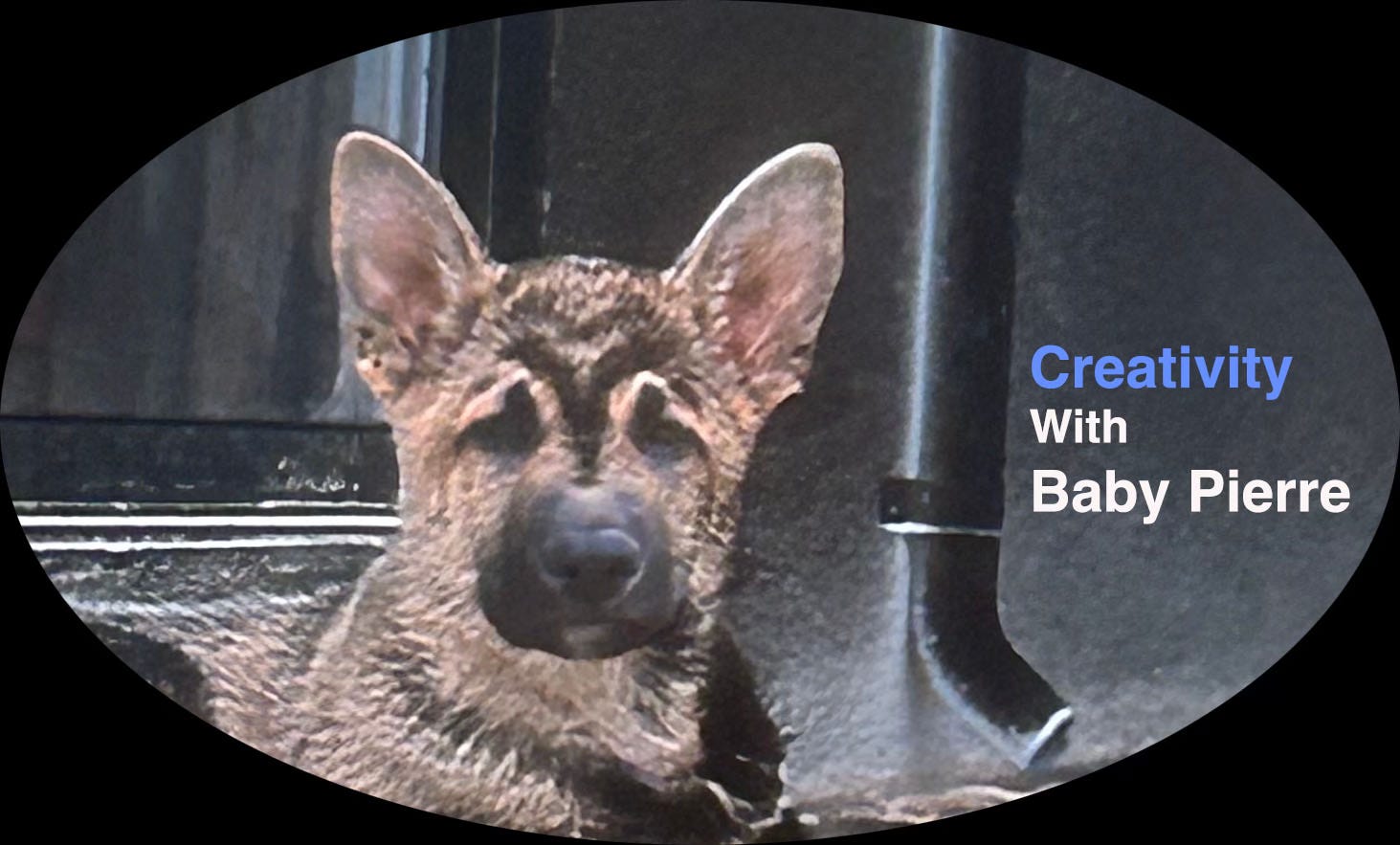
My little framed “portrait” of Baby Pierre here is an excerpt from a larger photograph I captured around 1977. The Portrait of Baby Pierre is important to me because Pierre played a big role in my family history. He was one of two family dogs we had at the time. Later, my own children grew up knowing him in his old age.
Pierre was a giant dog with a kind and sweet heart. If you played the baby grand piano in the living room he would come up to you and start singing—or howling really.
Pierre was also the subject of many portraits that I captured of him over the years. My Mom once painted a portrait of Pierre’s uncle (Michael Barnabas) who proceeded him in the family. There was also the 17x22 professionally framed photographic portrait of my parents from about 1985 that included Pierre and Brandy who was a Golden Labrador.
The Portrait of Baby Pierre is very different from your typical photograph or portrait. It’s different because of the innovative process I used to create the image.
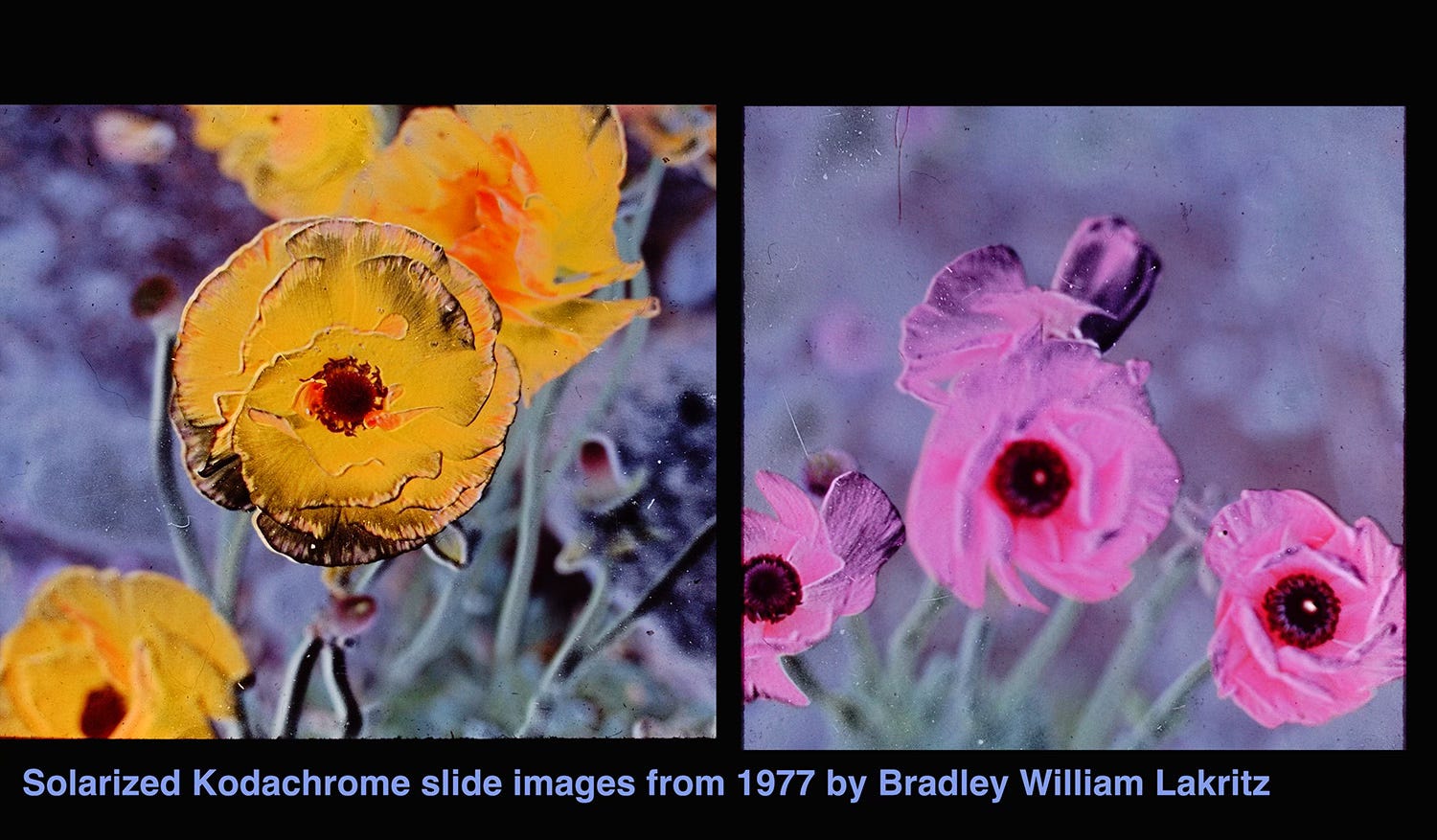
I took the portrait using a roll of 35mm Kodak Kodachrome color slide film with a Fujica camera. During the process of developing the film I exposed it to a very small amount of extra light which “solarized” the images on the roll of film.
During that time I captured other images using an infrared lens filter. You could also vary the process of creating an image by adding a filter when you shoot the image and then develop it or print a paper copy using a solarization process or other “tricks of the trade” in film photography.
In this way, Baby Pierre is not a picture printed in a negative format. It’s a positive archival digital print of a color slide that had been manipulated with extra light during development. Today, The Portrait of Baby Pierre looks like what we would call a “Photoshopped” image.
But these images were created a long time before Photoshop was invented.
One of my favorite things to ponder about these images is the impact of my high school photography teacher who taught me how to do it and came up with the lesson plan and photographic technology to make art in this way back in 1974.
I think about what he imagined might be the final product or what I called the “artifact” I assigned my students to submit for a given assignment. In those days, people looked at color slides using a slide projector and a dark room with a screen.
I’m sure Mr. Larson knew it was possible to print slide images to paper and display them as art in a frame. However, doing that in color was beyond our capacity at the time. That’s why he used color slide film because he knew we wouldn’t be able to print color print film in our darkroom anyway.
At least we could all see the images students created by having them projected in class.
But I wonder, could he have imagined I would keep that little plastic paper-framed slide for 50 years? Could he imagine I would print it to archival paper and mount it in museum quality framing and place it on a wall as art?
I would like to think so but I’m not sure he would have.
What do you think?
ART AND THE CREATIVE PROCESS
I am a photographer. Photography is where I create my best and most creative work.
I have drawn and painted over the years with some success. In 4th or 5th grade I created a painting that looked a little like a scene from the first Star Wars movie—although the movie had not come out by then.
The 8x10 framed watercolor piece had a mountain with caves and you could see “jets” that looked a bit like the ones Luke Skywalker flew into battle. The principal thought it was so good he wanted to hang it in his office. I was proud of it but I have never seen it since then.
In high school I painted a mural of a photograph of the front of my 1957 Chevy. For scale, look to the right of the photograph of the painting and you can see the bedroom light switch.
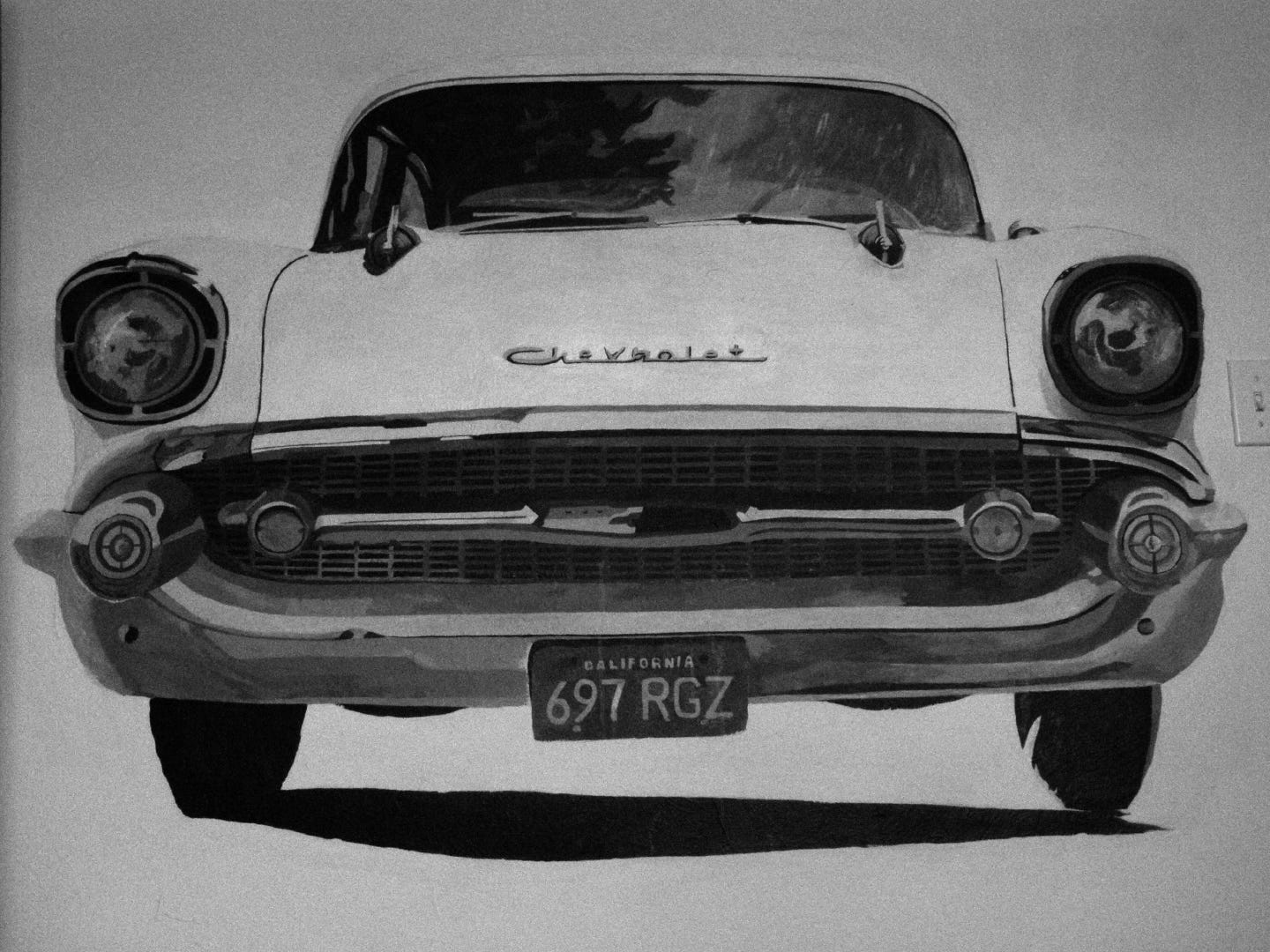
The making of that painting was an incredibly creative process that began with the decision to use the photograph as the “model” for the painting. However, even in my early days, I was also interested in using technology to get the job done more quickly, efficiently, and looking better.
I decided to use an opaque projector. Because my Dad was a teacher at the high school—and I knew a lot of teachers and librarians—I could get away with taking one of these projectors home.
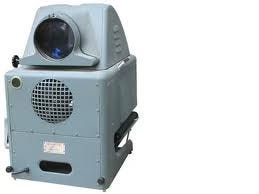
We used this device to project the photograph of the car on to the wall so we could then draw an outline of the image in pencil. However, the projector had to be placed outside the window of the bedroom for it to project the correct size and position on the wall.
So we had to do it at night!
Full disclosure, I also had two friends who ARE artist, and who do draw and paint, help me with that part of the mural and they each were proud of the parts they painted on the car.
Ironically, it’s a good thing I photographed the mural because in 2010 the family sold the home we had bought 50 years earlier and the mural went with the house.
Now I only have a photograph of a painting of a photograph I took. But I’m happy to have it.
ART SUPPORTS CREATIVITY IN EDUCATION AND SCHOOLS
I became a full time regular classroom teacher for the last 10 years of my career. I earned a California State Teaching Credential in Social Science and taught 8th grade American history.
Being in the Humanities Department at my school, I was often told in my first couple of years that I was an English teacher because I taught reading and writing. I learned that this was true—but I also learned I had become an art teacher.
As I described earlier, a truly creative process often comes without you noticing it right away. If you create a good thing it will last a long time and become part of who you are and what you do every day.
For me that turned out to be art more than anything else in my classroom.
History is often learned through the art created in the era you are learning about. Sometimes, as I’ve written before, the art or images come from newspapers, Editorial Cartoons, and today MEMEs.
That’s why I created the Student Political MEME Gallery on Instagram. It became a way for students to express their thoughts, ideas, and even feelings about what was happening in the world around them—from their perspective.
For students, it became a creative way for them to communicate their ideas.
I would give them a prompt like: “Political violence in America today”
Then, we might watch some video and have classroom discussion about anything related to the prompts or readings. Students would read an article or two and then create a Student Political MEME about it.

I had a lot of students. The last year I taught in San Francisco I had 187 students in middle school. Even though this assignment was optional, this project was fun and lots of kids participated. After the deadline for the assignment I put the best student MEMEs on a ballot of 15 or 20 MEMES. Students voted on the best MEMEs created by their peers and I posted the top 6 or 10.
CREATIVITY TAKES TIME AND EFFORT—BUT IT’S WORTH IT
In my last year teaching in San Francisco I had a student, like many others I had over the years, who did literally nothing academically in my class. He wasn’t a bad person and rarely disrupted what we did in class unless someone disrupted him.
In the last quarter of 8th grade we make it to the 20th century and I taught them about the impact of the KKK and other racial problems in America after the Civil War and during the 1950s and 1960s as Civil Rights became a big issue.
This student was so impacted by the story of men wearing robes and masks burning crosses in public, he decided to do a project for the first time all year. It took him about a week of classroom time to complete this drawing which was probably on a small 8x10 piece of paper.
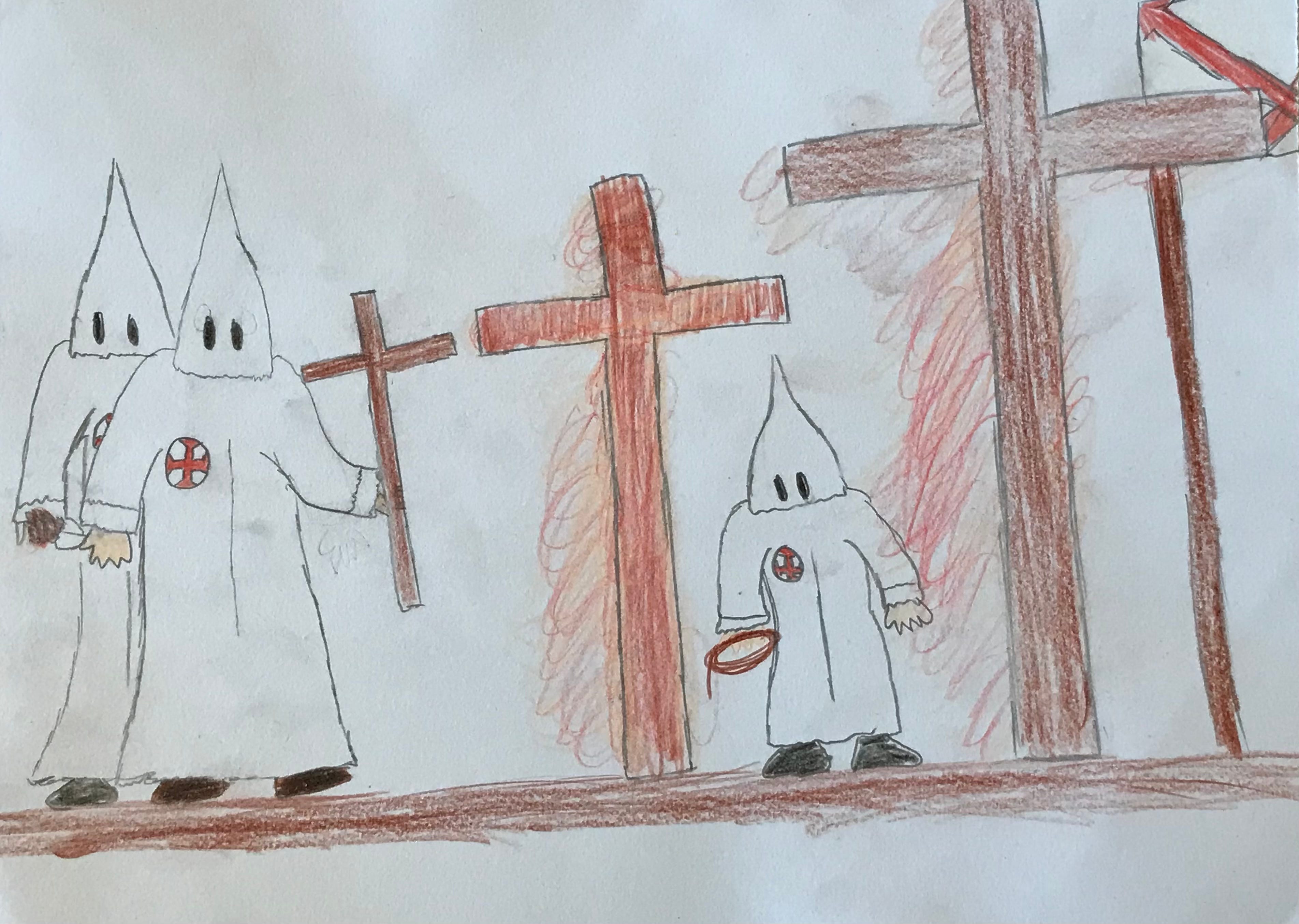
As he began to work on the drawing using the colored pencils I provided. I came by to ask how it was going and comment on how well I thought it looked each time he worked on it.
He began to ask questions. Questions like “How many crosses would they burn?” or, “Why did they always do it at night?”
Then he started asking questions about how to make the image look better. He was determined to not only complete the drawing, but also to have it look accurate to the scene. He was using a tablet to look up images and was using that as the model for his drawing.
His interest allowed me to teach him a little bit about visual perspectives and how that allows you to show size and distance in a drawing. Then I was able to help him find ways to draw the feet to show movement or marching.
I’m not sure my student understood the ways in which he was being creative. I am quite confident this student will never forget those stories we learned and the image he made about them.
I have hundreds of these stories and images to share along the way because that’s what Communicate Your Ideas is all about. I hope you will continue to read along while I Communicate My Ideas—and I am looking forward to you adding to the stories as well.
Creativity is an important skill that will help anyone be a better person and help build a better world for everyone.
As Tina Seelig said:
Creativity allows you to thrive in an ever changing world and unlocks a universe of possibilities.
Thanks for reading today and please answer the poll!
Also, paid subscribers will get a chance to see the final project I made with a group of students from around the world in my Crash Course on Creativity. The assignment was to make a video that promoted a creative idea at the time (2012). It’s a very interesting choice we made looking back from today’s world.
